Sunday, September 21, 2008

Business as Usual

Being that the last few months have been financially challenging for me, I'm going to use the Federal Reserve's new relaxed lending rules to get a low-interest loan. I wasn't sure if I had acceptable collateral, but standards have gotten rather loose. Thus, I was able to come up with some collateral that passed the (new) muster:


Okay, so standards haven't declined that far. Yet. However, the Powers That Be seem to be willing to lower standards as far as is necessary to sweep the whole credit crisis under the rug--to say, in essence, we weren't really playing for keepsies, that these millions of loans were just pretend mortgages.

The part of the bailout plan that really stinks is that Joe and Jane Taxpayer are going to get snookered twice. First, we're on the hook for the umpteen billion dollars (700, and if the politicians are saying 700 it's at least 850 and quite possibly over a trillion). What we don't pay back directly in the form of higher taxes, we'll pay in the form of inflation and eroded paychecks. But it doesn't end there. Just because the banks get to settle their books with virtual Monopoly money doesn't mean the banks will in turn allow us plebs to pay our mortgages with phony paper. Certainly not! We have to have standards and integrity, after all.

So while the banks get bailed out, homeowners in over their heads get foreclosure notices, evictions, and sacked credit scores for seven years (ten if they are unfortunate enough to have to file bankruptcy, and the same politicians that want to engineer this massive bailout made that more difficult a couple years ago).

There is, however, a silver lining for homeowners...at least some homeowners.

What the bailout essentially has done is to remove moral hazard from the mortgage loan underwriting business. When a bank places "bets" on the table by loaning consumers money, historically the banks had an incentive to be cautious. While frustrating for some consumers (especially those with marginal credit), this caution helped to limit the amount of money on the "table," which in turn kept housing prices in check.

Along about the year 1999 or so, that train left the track, banks began loosening standards, and more and more money sluiced into the housing market. Prices began their epic, irruptive rise to where they were last year. Trouble is, a lot of the money placed on the table by the banks was on bad numbers: people who couldn't pay it back.

What was supposed to happen next--what was in fact beginning to happen--is that the man overseeing the table (the market) reaches over with his croupier stick and pulls all the losing chips off the table. Those players whose resources are exhausted leave the table (go bankrupt), and the rest who placed wild bets...well, they learn a serious lesson about prudence and likely don't repeat their mistakes again. Those who placed rational, responsible bets profit, and become stronger and able to place more such bets in the future. With less money on the table, housing prices fall--which is what was happening.

But many of the players have a big, beefy, Nicky Santoro-type friend named Uncle Sam, and they get him to muscle the casino manager to not collect. So the players get to keep all their chips after all, even though by all rights many should have left the table poorer or downright broke.

What do you suppose happens after that? Anyone with even an associate's degree in human nature can tell you: the players are going to just throw out even more chips than before. Why shouldn't they? When it's "heads I win, tails the house loses," why not just throw those chips out there? The element of risk has been removed, so anything goes.

We'll hear a lot of noise about how standards for lending are being tightened and we're not going back to NINJA loans and blah blah blah. But politicians and laws and regulations can't change human nature. Only that fabled School of Hard Knocks and enforcement of risk can, and school's out. So the players are going to do what they believe will lead to the most profits, and that's going to be to place as many chips out there as possible.

If this bailout is approved, and the economy in general is at least well enough to fog a mirror, look for the housing market to reflate over the next year or two, as money pours back into it. We're essentially going to at least attempt to rebuild the housing bubble. How far we get depends on how long foreigners are willing to loan Uncle Sam the money to cover everyone's bets. When that lifeline disappears, we're in a world of hurt...

Thursday, September 18, 2008

Digging Holes in the Desert

Those of you who have seen the movie Casino probably remember De Niro's early line about the desert being the place where Las Vegas's real problems got solved. The movie was a (mostly) true-to-life depiction of how business was done when the Mob ran the city, and problematic people were disposed of in holes out there in the vast, dark expanse of the windswept desert...never to be seen again.

I lived in Vegas for a few years, and while I never saw any mobsters, I did hear about how, with the irruptive growth in the real estate market and suburban sprawl on steroids, Vegas Valley builders would occasionally unearth some old corpse from those notorious days.

Wall Street today has some real problems, with the decimals several places to the right of the worst problems the wiseguys ever had in running Vegas, and the high rollers have decided on the same outcome: digging holes in the desert. Like the Mob buried its "liabilities" in the dead of night, so the high masters of finance usually do their dirty work on the weekend, when the markets are closed.

We've already had some small holes dug and some lesser banks dropped in. That seemed to work, so now apparently the thinking is, no matter how big the corpse, it can be disposed of in an orderly fashion, and life can go on as if nothing is amiss. Now the idea has been broached of digging the mother of all holes (maybe we'll call it "MOAH") and just dropping all these subprime mortgages into it.

The line of thinking involved in creating a "financial entity" to absorb all of this and then quietly taking that entity out into the desert some night is classic Mafia mentality. The subprime mortgages, collectively, represent a great big fat blabbermouth that just won't shut up. Here the politicians keep glad-handing us and telling us "the fundamentals are strong," while this pesky trillion-plus in bad debt that was the froth on the bubble that propped it all up screams out otherwise, that we've got a major problem, that easy money and credit bubbles are no substitute for fiscal discipline, financial responsibility, prudent regulation, and common sense. So before the ultimate "gaming control board"--the American voter--starts to hear this blabbermouth "talking" about how one hand has been washing the other lo these many years, it's best for business if the blabbermouth were "silenced" permanently, and with extreme prejudice.

So look in the next couple weeks for this "entity" to be quickly named, and all of the bad debt to be sluiced into it. Then, probably sometime after the election, when the spotlight is elsewhere, the Powers that Be are going to duct-tape the entity, stick it into the trunk of a Buick, and drive it out into the financial desert.

However, the bad debt is only a symptom, not the actual problem. The problem still exists: the financial system is badly out of balance with reality. Houses are still overpriced. Eliminating the symptoms of imbalance merely encourage more imbalance. Moreover, the ability of even the Federal Reserve to dispose of this "corpse" without serious repercussions elsewhere in the system is questionable, given we're talking over a trillion dollars here.

What's worse is that The Powers That Be appear to be still stubbornly clinging to the mentality that houses must be an investment and must always increase in value so that Joe and Jane Consumer can cash out tens of thousands in equity every few years to finance cars and boats and vacations and whatnot out of thin air and "stimulate" the economy. As long as that fantasy is held so dear, the laws of economics will continue to have to be bent to make it come true...and we will have more meltdowns, more corrections, more Fannie Maes and Freddie Macs.

Thursday, September 11, 2008

Whatever Happened to Peak Oil?

As oil settles at one thin dime over $100, the question inevitably arises, "what happened to the oil crisis?" Wasn't oil supposed to get more and more expensive until we all had to ride horses? Dude, where's the oil shortage?

It's a fair question.

The answer, I fear, is that peak oil and the oil shortage are still very much with us. Even at $100 a barrel, oil is still up approximately 30% from where it was last year around this time. That's still quite an increase. But why is is going down at all?

There are several answers to this. First, that's what commodities tend to do. Market forces tend to kick in and over-correct for large price movements. If the price of widgets plunges 40% one year, people tend to buy more widgets and producers cut back on production. So a year or two later, widgets are likely going to be more expensive than they were before the widget crash began.

When oil got expensive, most of the low-hanging conservation fruit got picked. People checked their tire pressure, traded in those SUVs and bought economy cars, moved closer to the office, and so on. The economy itself wilted, reducing oil demand.

Other factors intervened, too. While oil production overall has peaked, most oilfields have marginal wells that are turned off when oil prices are low, but switched on when prices rise. Oil speculators also sensed the ride was over, and sold off oil futures. Some also believe the Bush Administration pulled some strings with the Saudis to get them to squeeze out some extra production to bring oil prices down in time for the election. I'm not going to say I necessarily believe that last item, but it wouldn't surprise me; his entreaties to the Saudis last spring are on the record.

So add all that together, and oil came partway back down. However, the forces that led to the last run-up in prices are very much in place. China, India and other developing countries are continuing to demand more oil. We continue to burn several times as much oil as we discover. More and more countries are shifting from being oil exporters to oil importers; Indonesia didn't bother to renew its OPEC membership because it now uses more oil than it pumps from domestic wells.

The difference is that, the next time a supply pinch occurs, we're going to have a harder time reducing demand. We've already traded in many of the SUVs, and otherwise taken the easy steps to conservation. And at some point, I'm sure we'd like the housing correction to end and for the economy to grow again...when it does, that means more oil consumption and higher prices. Of course we don't want to have to endure a recession every time oil prices go up just to get gas down below $4 a gallon.

But in the absence of vigorous conservation elsewhere, that's exactly the scenario we're looking at. And it gets worse from there: if production continues declining, we'll reach the point where even a recession won't tamp down demand for oil enough to bring prices below nosebleed levels.

The bottom line: don't be fooled. And for goodness' sake, don't start thinking it's safe to buy SUVs again. This is a temporary lull. If you started making plans to trade in for a more fuel-efficient vehicle but are wavering because you see gas prices falling, stay the course and make the trade. A few months or a year from now, you'll be glad you did.

Monday, September 8, 2008

Everyone Needs a Rich Uncle

Everyone, it seems, could use a rich uncle...like our favorite (?) uncle, Uncle Sam. Witness the federal takeover of Fannie Mae and Freddie Mac, those quasi public/private entities that underwrite much of the mortgage paper being written in America today.

First off, one has to wonder at just how two corporations, one named like a country schoolgirl and the other like a rap star, managed to get to be such bellwether names in High Finance. The answer lies in how both of these giants were implicitly, kinda-sorta backed by the government...at least until last weekend, when the "implicitly" and "kinda-sorta" were removed from the phrase "backed by the government."

Anytime a rich uncle stands behind an organization, even in the shadows backstage, the risk versus rewards assessment made by the operators of that organization get skewed. When risky decisions come up to be made, the operators can't help but think, "Well, if things go south, our rich uncle will save our hides, so why not throw the dice?" That's when speculation enters the picture...exactly the kind of speculation that took us down the primrose path to ruin in the housing market.

This mentality is what, at least in part, led up to "liar loans" and NINJAs ("No Income, No Job or Assets" loans made to anyone who could fog a mirror) that are floating belly-up across the country. When your rich uncle is standing by to absorb your losses, why not place risky bets?

And this is why the federal takeover is about the worst long-term event that could happen to the housing market. Sure, it's lowering rates, but is that what we really need? The whole problem began with a skewed risk-versus-rewards assessment on the part of these and other organizations. History has shown that, while private enterprise is often imperfect at gauging these matters, the state is far worse. Government running such a huge sector of the economy brings to mind that dreaded "s"-word: socialism.

For private enterprise, the main incentive to place responsible bets is the threat of loss--and, at the extreme, total loss (going out of business). Left to its own devices, the market usually administers discipline to those who bet irresponsibly. The "housing crash" was, in fact, just that correction in action. The banks going out of business, while painful for shareholders, was the whack with a switch on the rear end out back of the woodshed that the lenders needed.

Up until this weekend, Uncle Sam was doing the responsible thing and letting the market administer whuppings (while protecting depositors who had nothing to do with where the "chips" were placed on the table). And banks, hearing the excruciating sound of leather and wood hitting the financial flesh of their peers, were responding by tightening standards and curtailing the easy money that caused the problem in the first place.

But now, just when the punishment was beginning to modify behavior, Uncle Sam steps in to call it off. The message that is being sent--and, IMHO, it's highly detrimental to the healthy functioning of a capitalist economy--is that dysfunctional practices won't be punished if the punishment is "too painful." The problem with that is that the most painful punishments tend to result from the most dysfunctional behaviors...like basing a large part of a superpower's economy on the premise that housing values can only go up.

These are the behaviors that most urgently need to be corrected. They will be corrected...one way or another. All Uncle Sam did was postpone--and worsen--that day of reckoning.

Thursday, August 28, 2008

GDP Grew Last Quarter. Does it Matter?

The question of how the U.S. economy as a whole fared during the second quarter of 2008 has been answered...supposedly. GDP, which is the sum total of all goods and services produced within our borders, adjusted to avoid counting added value twice, for trade deficits, and quite possibly for the number of daily riders on "it's a small world after all," managed to grow 3.3%.

Economists were thrilled, and no doubt whoever runs the McCain campaign cracked a smile. Justifiably or not, McCain is seen by a sizable fraction of the electorate to be a successor to Bush, so whatever reflects well on Bush will give him a boost, too.

However, 3.3% really isn't that high a rate of growth, not by historical standards. It's not terrible. It puts a comfortable distance between the economy and that dreaded "R" word, at least for now. If the GDP report had been a golf stroke, the crowd would break out in polite but not particularly enthusiastic applause. At this juncture, since expectations had been a half to full percentage-point lower, 3.3% fills that proverbial square for the heirs-apparent to current politicians: the economy isn't great, but it wasn't as bad as we were all afraid it would be.

However, I see two problems with using GDP as a tool to measure the economy.

First, citing GDP growth as evidence that Things Are Getting Better carries with it an implicit but very real assumption that everybody's economy is growing 3.3%. The Powers that Be want us to believe that Richie Rich, CEO of Whatever, Inc. took home an extra 3.3%, and that his middle managers also took home 3.3% more, and that the rank and file at the factory took home 3.3% more, and the drivers of company trucks got 3.3%, and that overall everything is peachy-keen.

However, as you might imagine, that's quite an oversimplification. If we take a look at this past decade, we can see plainly that a rising tide has not, in fact, lifted all boats. So a simple increase in GDP is not a guarantee, nor even a reliable indicator of, an increase in our standard of living.

So how can we measure standard of living? The simplest method is to divide GDP by population, but this still just measures an average, saying nothing about distribution. So, several economists are trying out complete rethinks of the GDP statistic, factoring in equality of income, life expectancy, vacation time, and other variables which also impact quality of life. The theory goes that someone who makes, say, $35,000 a year but enjoys a good education and transportation system,
a low crime rate, substantial freedoms, paid vacation and a clean environment might well be happier than someone making $50,000 but with no social safety net, failing schools, no time off, a corrupt and dictatorial government, and polluted air and water. More wealth is not always better.

For some examples of alternative systems, check out
Genuine Progress Indicator
Human Development Index
Happy Planet Index
f

The second problem I have with reading too much into that 3.3% growth was that the number was skewed by the tax rebate ("economic stimulus") checks being sent out. The money is borrowed money, and so the resultant increase in income is no more genuine than a guy who gets a $300 cash advance on his MasterCard claiming his income went up $300. It didn't; he just borrowed the money. So some of that 3.3%, we borrowed. How much? No one can determine with certainty, but it's safe to say some of it.

So, aside from a new generation of economic indicators, how can we know the economy is really improving? Some indicators to watch for: a reduction of inflation (inflation having a corrosive effect on the buying power of consumers) and increases in personal income and employment. These indicators, more than raw GDP, would show a nation on the mend.

Monday, August 18, 2008

Breathing a Little Sigh of Relief

My apologies for the month hiatus. I was moving, and dealing with some personal crises. Fortunately, the situation seems to have stabilized. Things still aren't really where I would like them to be, but things have eased from red alert to a slightly orangish yellow.

You could say the same about the U.S. economy the past few weeks...not out of the woods, but breathing a little sigh of relief. The prime mover of the economy, oil, has eased from an economy-throttling $143 a barrel down to a merely painful $113. The spike in interest rates that was threatening to send the housing market into another death-spiral reversed a bit and then plateaued. The dollar has even regained a little ground. In short, things aren't back to what we want to call "normal," but we're no longer--for now at least--in acute crisis.

So how big a sigh of relief can we breathe? I would say, not very. Unfortunately, none of the underlying forces that made oil more expensive, the dollar lower, and interest rates higher have been dealt with. The fundamental imbalances between supply and demand of oil still exist in the long run, even if a reduction of demand in the short run has caused what I believe to be a temporary retreat in oil prices.

The problem is that we are entering an era of permanent decline for oil production. Thus, in order for price to keep declining, demand has to keep declining...as it has in the U.S. for the past several months. The only way demand can decline, other than a reduction in the population, is through conservation. (In the long run, hopefully we'll develop substitutes for oil, but for the next decade at least, we're pretty much stuck with petroleum as the prime mover for our economy.)

Energy conservation is a noble idea, and almost everybody seems to want to practice it...at least in the beginning. We've been doing a decent job of it for the past year or so, which is one of the reasons oil prices have declined. But the problem is that each subsequent reduction in energy usage gets progressively more inconvenient and difficult. Think about your own use of energy. Unless you're already an energy-conscious person, you could probably reduce your total consumption by 10% without significant changes to your lifestyle. Inflate tires properly, be careful to turn out lights, maybe bump the air-conditioner thermostat up a degree or so, avoid jackrabbit starts, and so on. That's pretty much what we did as a nation to shave oil consumption in the first half of this year.

However, energy conservation gets progressively more difficult and painful the more one is called upon to conserve. That first 10% or so of reduction was easy, but the second 10% requires more conscious effort. And the third 10% reduction...now we're talking some real lifestyle changes, like trading in the SUV for a Hyundai or even a hybrid, moving so you're fifteen minutes from work instead of an hour and a half. To sustain and further the reduction in oil usage, we're talking about changes as a society. We're talking bosses giving up control-freakery and letting office workers work from home offices a couple days a week. We're talking about car lots not seeking to be seen from space a la the Luxor in Las Vegas every night, and shutting off or dimming their lights. We're talking fewer nights out on the town, and more nights at home.

Is it possible? Yes. Is it going to be easy? No. Reducing our use of oil to the level necessary in the next decade to make oil a viable energy source is going to challenge some of our core beliefs about what the "American Way of Life" (which is actually a fairly recent cheap-oil invention) ought to be. There'll be push-back from companies and groups who stand to lose if change occurs.

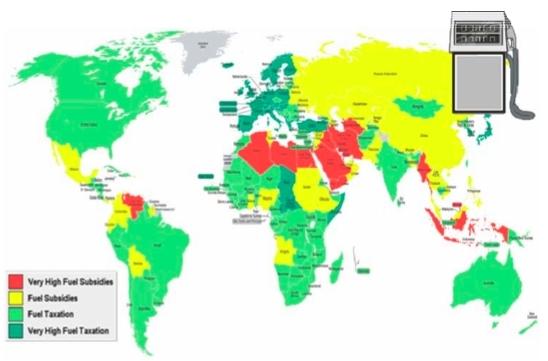
But if you think that's bad, console yourself (if you want to) with the fact other societies around the world are going to be facing even more wrenching changes and hard choices: most notably China. While China is making some progress in becoming more energy-efficient, it still has a long ways to go. The Chinese practice of subsidizing fuel will also work against it, as those subsidies will grow more expensive as oil appreciates. Check out this map...the nations in yellow are going to be in for a rough ride, and those red nations that do not produce at least most of the oil they consume will have a worse time of it.

So my advice to Americans is to make the most of the economic uptick we seem to be experiencing (or will be experiencing once the fall in oil prices percolates through the economy and helps tamp down price pressures). Use this time to begin adjusting to a lower-energy future. Pay down your debts, sell that SUV in a couple months once the gullible begin to become convinced gasoline prices have returned to "normal," try to get closer to your job, and so on.

Breathe a sigh of relief, but don't be fooled. We're not out of this one yet.

Saturday, July 19, 2008

Bad Credit? No Credit? All About Credit and FICO Scores

Mention credit scoring or FICO to most people, and you've got a conversation topic that's about as pleasant as income tax or root canals. "That's going to go onto your credit report" evokes much the same loathing from a modern consumer as "that's going on your permanent record" got from a schoolchild a couple decades or further back.

As recently as a couple years ago, credit scoring in general, and FICO scores in particular, were almost mystical entities that were all-but-inaccessible to the average consumer. Sure, you could pony up ten to twelve bucks and get your score, but there was no guide to interpreting the furlongs-per-fortnight number you got, and only cryptic hints as to why your score was the way it was. I remember rather vividly pulling my score a few years back, and under the explanation was indecipherable gobbledygook that even a lawyer would have had difficult wading through. I finally told the lady at the bank it would be much simpler for the computer to just print the words YOU SUCK! at the top of the page--that at least would have been clear.

Google wasn't even your friend then...you could enter in a credit scoring topic and get five different answers, some contradictory, none authoritative. It was enough to make someone with bad credit put their fist through their own monitor. What made this supremely annoying was that your credit score was--and is--a major indicator of your financial life. Not knowing your credit score and trying to plan things like mortgages and car purchases is like not knowing your weight, blood pressure and cholesterol levels and trying to manage your health. A good credit score can save you enough money (through lower interest rates) over the life of a 30-year mortgage to buy a whole new house.

What a difference a few years makes. While misinformation still exists on the Internet and elsewhere, consumers now have authoritative, easy-to-understand sources of information to turn to to acquire, understand, and manage their credit scores. For starters, you can order real Fico Scores/Reports
online by clicking the link in this sentence.

Think you're already getting FICO scores? Maybe, maybe not. Unfortunately, there are many non-FICO credit scores offered by banks and other vendors that are not the same as FICO scores. These scores often deviate from FICO scores by dozens, sometimes even around a hundred points. Since mortgage lenders, car loan providers, credit card companies, and most other creditors use FICO scores, FICO scores are the scores you want to obtain. If you currently get a "credit score" for free with a checking account, credit card, or other service, chances are it's not a true FICO score and therefore is not indicative of where you actually stand with prospective lenders.

The FICO scores available via the link above come with a copy of your credit report. Moreover, the score reports also contain detailed, easy-to-understand annotation that tells you why your score is where it is, and what you can do to improve it. Gone are the Magic 8-Ball type cryptic numbers and code-words.

As part of my effort to educate consumers on how to profit from the current economy, I have put together a Web site (and I'm talking a real site, not some crappy link farm) called www.allaboutthebenjamins.org that gives detailed information on FICO scoring. The site shows you how to improve your FICO score yourself without resorting to gimmicks or costly and often ineffective credit repair services. My site helps you improve your score by enabling you to understand and correct the factors that lower it rather than applying Band-Aid "solutions" like renting other people's lines of credit.

Once you've ordered your scores and checked out my Web site, continue on to the FICO Forums, which contain the most well-informed user base on the planet concerning FICO scoring and credit issues in general. Overstating just how knowledgeable and willing to help the denizens of the FICO Forums are would be rather difficult; there are some Vulcan-class brains over there.

This is the Information Age. Be informed, and take command of your credit. We're coming up on some unprecedented opportunities to buy housing on the cheap, and you don't want to be left out.