The question of how the U.S. economy as a whole fared during the second quarter of 2008 has been answered...supposedly. GDP, which is the sum total of all goods and services produced within our borders, adjusted to avoid counting added value twice, for trade deficits, and quite possibly for the number of daily riders on "it's a small world after all," managed to grow 3.3%.
Economists were thrilled, and no doubt whoever runs the McCain campaign cracked a smile. Justifiably or not, McCain is seen by a sizable fraction of the electorate to be a successor to Bush, so whatever reflects well on Bush will give him a boost, too.
However, 3.3% really isn't that high a rate of growth, not by historical standards. It's not terrible. It puts a comfortable distance between the economy and that dreaded "R" word, at least for now. If the GDP report had been a golf stroke, the crowd would break out in polite but not particularly enthusiastic applause. At this juncture, since expectations had been a half to full percentage-point lower, 3.3% fills that proverbial square for the heirs-apparent to current politicians: the economy isn't great, but it wasn't as bad as we were all afraid it would be.
However, I see two problems with using GDP as a tool to measure the economy.
First, citing GDP growth as evidence that Things Are Getting Better carries with it an implicit but very real assumption that everybody's economy is growing 3.3%. The Powers that Be want us to believe that Richie Rich, CEO of Whatever, Inc. took home an extra 3.3%, and that his middle managers also took home 3.3% more, and that the rank and file at the factory took home 3.3% more, and the drivers of company trucks got 3.3%, and that overall everything is peachy-keen.
However, as you might imagine, that's quite an oversimplification. If we take a look at this past decade, we can see plainly that a rising tide has not, in fact, lifted all boats. So a simple increase in GDP is not a guarantee, nor even a reliable indicator of, an increase in our standard of living.
So how can we measure standard of living? The simplest method is to divide GDP by population, but this still just measures an average, saying nothing about distribution. So, several economists are trying out complete rethinks of the GDP statistic, factoring in equality of income, life expectancy, vacation time, and other variables which also impact quality of life. The theory goes that someone who makes, say, $35,000 a year but enjoys a good education and transportation system,
a low crime rate, substantial freedoms, paid vacation and a clean environment might well be happier than someone making $50,000 but with no social safety net, failing schools, no time off, a corrupt and dictatorial government, and polluted air and water. More wealth is not always better.
For some examples of alternative systems, check out
Genuine Progress Indicator
Human Development Index
Happy Planet Index
f
The second problem I have with reading too much into that 3.3% growth was that the number was skewed by the tax rebate ("economic stimulus") checks being sent out. The money is borrowed money, and so the resultant increase in income is no more genuine than a guy who gets a $300 cash advance on his MasterCard claiming his income went up $300. It didn't; he just borrowed the money. So some of that 3.3%, we borrowed. How much? No one can determine with certainty, but it's safe to say some of it.
So, aside from a new generation of economic indicators, how can we know the economy is really improving? Some indicators to watch for: a reduction of inflation (inflation having a corrosive effect on the buying power of consumers) and increases in personal income and employment. These indicators, more than raw GDP, would show a nation on the mend.
Thursday, August 28, 2008


Monday, August 18, 2008
Breathing a Little Sigh of Relief
My apologies for the month hiatus. I was moving, and dealing with some personal crises. Fortunately, the situation seems to have stabilized. Things still aren't really where I would like them to be, but things have eased from red alert to a slightly orangish yellow.
You could say the same about the U.S. economy the past few weeks...not out of the woods, but breathing a little sigh of relief. The prime mover of the economy, oil, has eased from an economy-throttling $143 a barrel down to a merely painful $113. The spike in interest rates that was threatening to send the housing market into another death-spiral reversed a bit and then plateaued. The dollar has even regained a little ground. In short, things aren't back to what we want to call "normal," but we're no longer--for now at least--in acute crisis.
So how big a sigh of relief can we breathe? I would say, not very. Unfortunately, none of the underlying forces that made oil more expensive, the dollar lower, and interest rates higher have been dealt with. The fundamental imbalances between supply and demand of oil still exist in the long run, even if a reduction of demand in the short run has caused what I believe to be a temporary retreat in oil prices.
The problem is that we are entering an era of permanent decline for oil production. Thus, in order for price to keep declining, demand has to keep declining...as it has in the U.S. for the past several months. The only way demand can decline, other than a reduction in the population, is through conservation. (In the long run, hopefully we'll develop substitutes for oil, but for the next decade at least, we're pretty much stuck with petroleum as the prime mover for our economy.)
Energy conservation is a noble idea, and almost everybody seems to want to practice it...at least in the beginning. We've been doing a decent job of it for the past year or so, which is one of the reasons oil prices have declined. But the problem is that each subsequent reduction in energy usage gets progressively more inconvenient and difficult. Think about your own use of energy. Unless you're already an energy-conscious person, you could probably reduce your total consumption by 10% without significant changes to your lifestyle. Inflate tires properly, be careful to turn out lights, maybe bump the air-conditioner thermostat up a degree or so, avoid jackrabbit starts, and so on. That's pretty much what we did as a nation to shave oil consumption in the first half of this year.
However, energy conservation gets progressively more difficult and painful the more one is called upon to conserve. That first 10% or so of reduction was easy, but the second 10% requires more conscious effort. And the third 10% reduction...now we're talking some real lifestyle changes, like trading in the SUV for a Hyundai or even a hybrid, moving so you're fifteen minutes from work instead of an hour and a half. To sustain and further the reduction in oil usage, we're talking about changes as a society. We're talking bosses giving up control-freakery and letting office workers work from home offices a couple days a week. We're talking about car lots not seeking to be seen from space a la the Luxor in Las Vegas every night, and shutting off or dimming their lights. We're talking fewer nights out on the town, and more nights at home.
Is it possible? Yes. Is it going to be easy? No. Reducing our use of oil to the level necessary in the next decade to make oil a viable energy source is going to challenge some of our core beliefs about what the "American Way of Life" (which is actually a fairly recent cheap-oil invention) ought to be. There'll be push-back from companies and groups who stand to lose if change occurs.
But if you think that's bad, console yourself (if you want to) with the fact other societies around the world are going to be facing even more wrenching changes and hard choices: most notably China. While China is making some progress in becoming more energy-efficient, it still has a long ways to go. The Chinese practice of subsidizing fuel will also work against it, as those subsidies will grow more expensive as oil appreciates. Check out this map...the nations in yellow are going to be in for a rough ride, and those red nations that do not produce at least most of the oil they consume will have a worse time of it.
So my advice to Americans is to make the most of the economic uptick we seem to be experiencing (or will be experiencing once the fall in oil prices percolates through the economy and helps tamp down price pressures). Use this time to begin adjusting to a lower-energy future. Pay down your debts, sell that SUV in a couple months once the gullible begin to become convinced gasoline prices have returned to "normal," try to get closer to your job, and so on.
Breathe a sigh of relief, but don't be fooled. We're not out of this one yet.
You could say the same about the U.S. economy the past few weeks...not out of the woods, but breathing a little sigh of relief. The prime mover of the economy, oil, has eased from an economy-throttling $143 a barrel down to a merely painful $113. The spike in interest rates that was threatening to send the housing market into another death-spiral reversed a bit and then plateaued. The dollar has even regained a little ground. In short, things aren't back to what we want to call "normal," but we're no longer--for now at least--in acute crisis.
So how big a sigh of relief can we breathe? I would say, not very. Unfortunately, none of the underlying forces that made oil more expensive, the dollar lower, and interest rates higher have been dealt with. The fundamental imbalances between supply and demand of oil still exist in the long run, even if a reduction of demand in the short run has caused what I believe to be a temporary retreat in oil prices.
The problem is that we are entering an era of permanent decline for oil production. Thus, in order for price to keep declining, demand has to keep declining...as it has in the U.S. for the past several months. The only way demand can decline, other than a reduction in the population, is through conservation. (In the long run, hopefully we'll develop substitutes for oil, but for the next decade at least, we're pretty much stuck with petroleum as the prime mover for our economy.)
Energy conservation is a noble idea, and almost everybody seems to want to practice it...at least in the beginning. We've been doing a decent job of it for the past year or so, which is one of the reasons oil prices have declined. But the problem is that each subsequent reduction in energy usage gets progressively more inconvenient and difficult. Think about your own use of energy. Unless you're already an energy-conscious person, you could probably reduce your total consumption by 10% without significant changes to your lifestyle. Inflate tires properly, be careful to turn out lights, maybe bump the air-conditioner thermostat up a degree or so, avoid jackrabbit starts, and so on. That's pretty much what we did as a nation to shave oil consumption in the first half of this year.
However, energy conservation gets progressively more difficult and painful the more one is called upon to conserve. That first 10% or so of reduction was easy, but the second 10% requires more conscious effort. And the third 10% reduction...now we're talking some real lifestyle changes, like trading in the SUV for a Hyundai or even a hybrid, moving so you're fifteen minutes from work instead of an hour and a half. To sustain and further the reduction in oil usage, we're talking about changes as a society. We're talking bosses giving up control-freakery and letting office workers work from home offices a couple days a week. We're talking about car lots not seeking to be seen from space a la the Luxor in Las Vegas every night, and shutting off or dimming their lights. We're talking fewer nights out on the town, and more nights at home.
Is it possible? Yes. Is it going to be easy? No. Reducing our use of oil to the level necessary in the next decade to make oil a viable energy source is going to challenge some of our core beliefs about what the "American Way of Life" (which is actually a fairly recent cheap-oil invention) ought to be. There'll be push-back from companies and groups who stand to lose if change occurs.
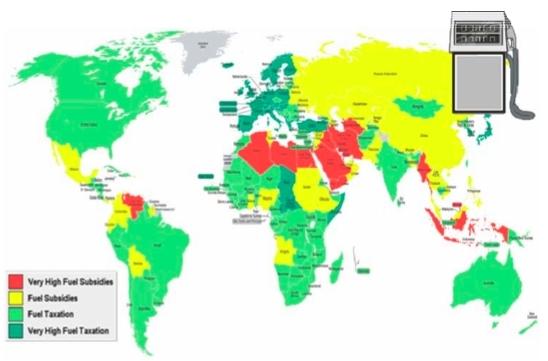
But if you think that's bad, console yourself (if you want to) with the fact other societies around the world are going to be facing even more wrenching changes and hard choices: most notably China. While China is making some progress in becoming more energy-efficient, it still has a long ways to go. The Chinese practice of subsidizing fuel will also work against it, as those subsidies will grow more expensive as oil appreciates. Check out this map...the nations in yellow are going to be in for a rough ride, and those red nations that do not produce at least most of the oil they consume will have a worse time of it.
So my advice to Americans is to make the most of the economic uptick we seem to be experiencing (or will be experiencing once the fall in oil prices percolates through the economy and helps tamp down price pressures). Use this time to begin adjusting to a lower-energy future. Pay down your debts, sell that SUV in a couple months once the gullible begin to become convinced gasoline prices have returned to "normal," try to get closer to your job, and so on.
Breathe a sigh of relief, but don't be fooled. We're not out of this one yet.
Subscribe to:
Posts (Atom)